

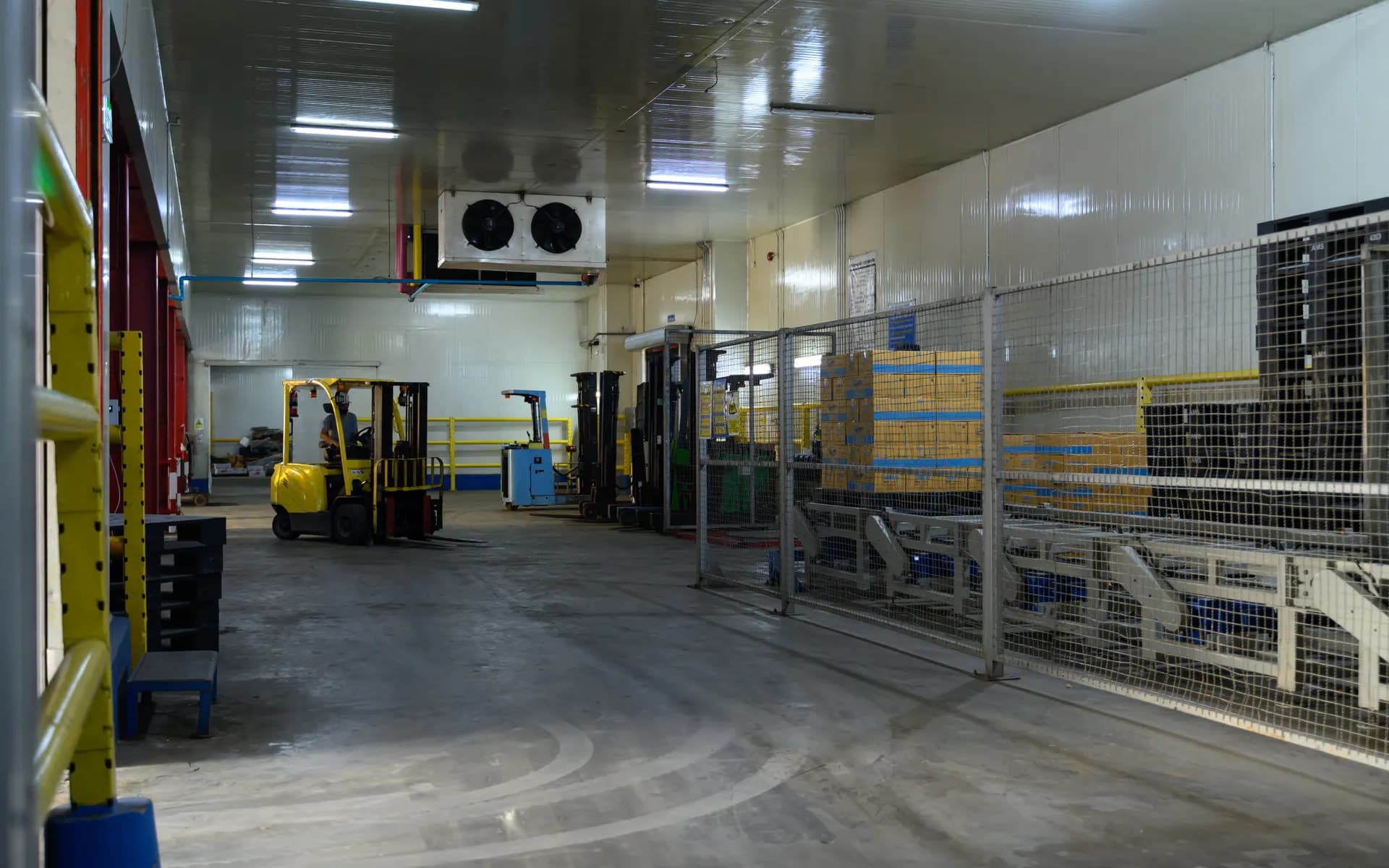
Cold Storage and
Warehouse Monitoring
Fixed wired and wireless IoT sensor nodes that mount inside cold rooms, blast freezers, chambers, and ambient warehouses. RTD and digital sensors map temperature and humidity across every zone, reed switches catch door-open events, and the platform escalates alarms by SMS, call, and email the moment a zone drifts out of band. Battery and UPS backup keep the data flowing through a power cut, and every reading lands in a tamper-evident audit log for food safety and pharma authorities.
 THE CHALLENGE
A Blind Spot in a Cold Room Is a Recall Waiting to Happen
A walk-in freezer or a pharma store holds product whose value depends entirely on staying inside a temperature band, yet most sites monitor it with a single dial thermometer and a clipboard checked twice a shift. A compressor that fails at 2am, a door propped open during a shift change, or a defrost cycle that runs long can push a whole zone out of spec for hours before anyone notices, and the loss is not one box, it is the whole chamber plus the cost of proving to an auditor that the rest stayed safe. Strapping a delivery-bag logger to a shelf does not solve this. Fixed sensor nodes wired into the building map every zone and raise a human the instant a reading drifts, so the failure is caught in minutes instead of at the next manual round.
Part of the Telematics and GPS Tracking stack, and commonly built alongside Cold Chain Monitoring.
WHAT'S INCLUDED
A Fixed Cold Storage Monitoring System
Fixed Wired Sensor Nodes
Wall-mounted nodes are built around STM32 or ESP32 hosts running FreeRTOS, wired into building power with PT100 or PT1000 RTD probes for cold rooms and digital temperature and humidity sensors for ambient bays. Each node reads on a fixed interval, holds its own buffer, and reports over Ethernet, PoE, or RS-485 Modbus to a site gateway.
Multi-Zone Temperature and Humidity Mapping
One chamber is rarely one temperature. Probes sit at the warm and cold corners, near the evaporator, and at product height, so you map the real gradient instead of trusting a single sensor by the door. Humidity nodes track dew point in chillers where condensation, as much as temperature, decides shelf life.
Door and Defrost Event Detection
Magnetic reed switches on every door log open and close events with timestamps, so a propped door triggers an alarm before the zone warms. Defrost cycles are detected from the temperature signature, suppressing nuisance alarms during a known cycle while still flagging a defrost that runs too long or fails to recover.
Multi-Level Alarm Escalation
When a zone drifts past its threshold the alarm escalates in stages. An early warning emails the duty manager, a sustained excursion sends SMS, and a critical breach places an automated voice call and pages the on-call list until someone acknowledges. You set the bands, delays, and the escalation chain per zone.
Compliance Audit Logs and Reports
Every reading is written to a tamper-evident log with the sensor ID, calibration reference, and timestamp. The temperature charts, excursion summaries, and signed reports that food safety and pharma authorities ask for are generated automatically, so an audit is an export instead of a week of reconstructing paper records.
Redundancy and Battery Backup
Monitoring that dies with the mains is no monitoring at all. Each node carries battery backup and the site gateway runs on a UPS, so when a power cut takes the building offline the system keeps reading, keeps timestamping, and keeps alerting over Cat-M1 or NB-IoT cellular when the wired link is down.
WHAT YOU GET
Proof Your Cold Chain Held, Zone by Zone
You stop running your cold storage on twice-a-shift manual rounds and start managing it from live data. The system answers the questions that decide whether product is safe to ship and whether an auditor signs off.
Is Every Zone In Band Right Now
A live dashboard shows the current temperature and humidity of each chamber, freezer, and bay against its limits, with the last reading time, so a drifting zone is visible at a glance instead of at the next paper round.
What Happened Overnight
Every excursion, door event, and defrost cycle is logged with timestamps. When a zone warmed at 3am you see how far, how long, what caused it, and exactly when it recovered, which decides whether that product still ships.
Can You Prove It To An Auditor
The audit log and signed reports give a food safety or pharma inspector a continuous record per sensor, with calibration references, so compliance is an export you hand over rather than a paper trail you scramble to rebuild.
HOW IT WORKS
From Probe Reading to Acknowledged Alarm
Nodes Sample and Buffer
Each fixed node reads its RTD and humidity probes on a set interval, checks the reading against the zone band, and stores it locally. If the network drops the buffer holds the data until the link returns, so no reading is lost during an outage.
Gateway Aggregates and Publishes
The site gateway collects nodes over Ethernet, PoE, or RS-485 Modbus, normalizes the readings, and publishes them to the cloud over MQTT secured with TLS. On a wired failure it falls back to Cat-M1 or NB-IoT cellular so alerts still get out.
Cloud Evaluates and Escalates
The backend writes each reading to the audit log, runs it through the alarm rules per zone, and starts the escalation chain on an excursion, moving from email to SMS to voice call until a named person acknowledges the alarm.
ENGINEERING DETAIL
Built For A Minus Forty Freezer, Hardened Well Beyond A Server Room
Calibration and Validation
A reading you cannot trust is worse than no reading. NIST-traceable calibration is supplied on the RTD probes, the calibration reference is stored against every channel, and periodic re-validation is supported, so an auditor sees a sensor whose accuracy is documented and current.
Sealed For Cold And Wet
Nodes in a freezer face frost, condensation, and washdown. The electronics are housed to IP65, the probe cable runs through a sealed gland, and the node is qualified across the full chamber range so it keeps reading at minus forty and through a defrost thaw.
Survives The Power Cut
Each node is designed with battery backup and the gateway on a UPS, with cellular fallback, so a mains failure that takes out the building does not blind the monitoring. The system keeps logging and alerting through the outage and reconciles cleanly when power returns.
Open Integration
Readings, events, and reports are exposed through REST APIs and webhooks, and existing controllers are read over RS-485 Modbus, so cold storage data flows into your WMS, BMS, or quality system instead of sitting in a separate silo.
FAQ
Common Questions
How is this different from a delivery temperature logger?
A delivery logger rides in a bag or a truck and tells you about one trip. This is fixed warehouse infrastructure. The nodes are wired into the building and mounted permanently in your cold rooms, freezers, and chambers, mapping every zone continuously instead of one shipment at a time. It is built to monitor the storage itself, while a delivery logger covers the journey out the door.
What happens to monitoring during a power cut?
Each node carries battery backup and the site gateway runs on a UPS, so the system keeps reading and timestamping through the outage. If the wired network is also down it falls back to Cat-M1 or NB-IoT cellular, so alarms still reach the on-call list even when the building has lost mains power.
Can it tell a real excursion from a routine defrost cycle?
Yes. The defrost signature is detected from the temperature curve, so nuisance alarms during a known cycle are suppressed while a defrost that runs too long or fails to recover to setpoint is still flagged. Door reed switches add context, so a brief open during a stock movement is logged without paging anyone needlessly.
How does the alarm escalation work?
You set a band, a delay, and an escalation chain per zone. An early warning emails the duty manager, a sustained excursion sends SMS, and a critical breach places an automated voice call and pages the on-call list until someone acknowledges. The escalation stops the moment a named person confirms they are handling it.
Are the sensors calibrated for audits?
NIST-traceable calibration is supplied on the RTD probes and the calibration reference is stored against every channel, with support for periodic re-validation. Every reading in the audit log carries its sensor ID and calibration reference, so a food safety or pharma auditor sees accuracy that is documented and current.
Can this integrate with your existing WMS or building system?
Yes. Readings, events, and reports are exposed through REST APIs and webhooks, and existing controllers are read over RS-485 Modbus. Cold storage data flows into your WMS, building management system, or quality platform instead of living in a separate tool nobody checks.
Ready to See Every Cold Zone in Real Time?
Share your chambers, freezers, and ambient bays, your temperature bands, and the compliance reports you need to get a tailored approach and a realistic timeline for a fixed sensor network that catches an excursion in minutes and proves your cold chain held.
Schedule a Free Consultation