
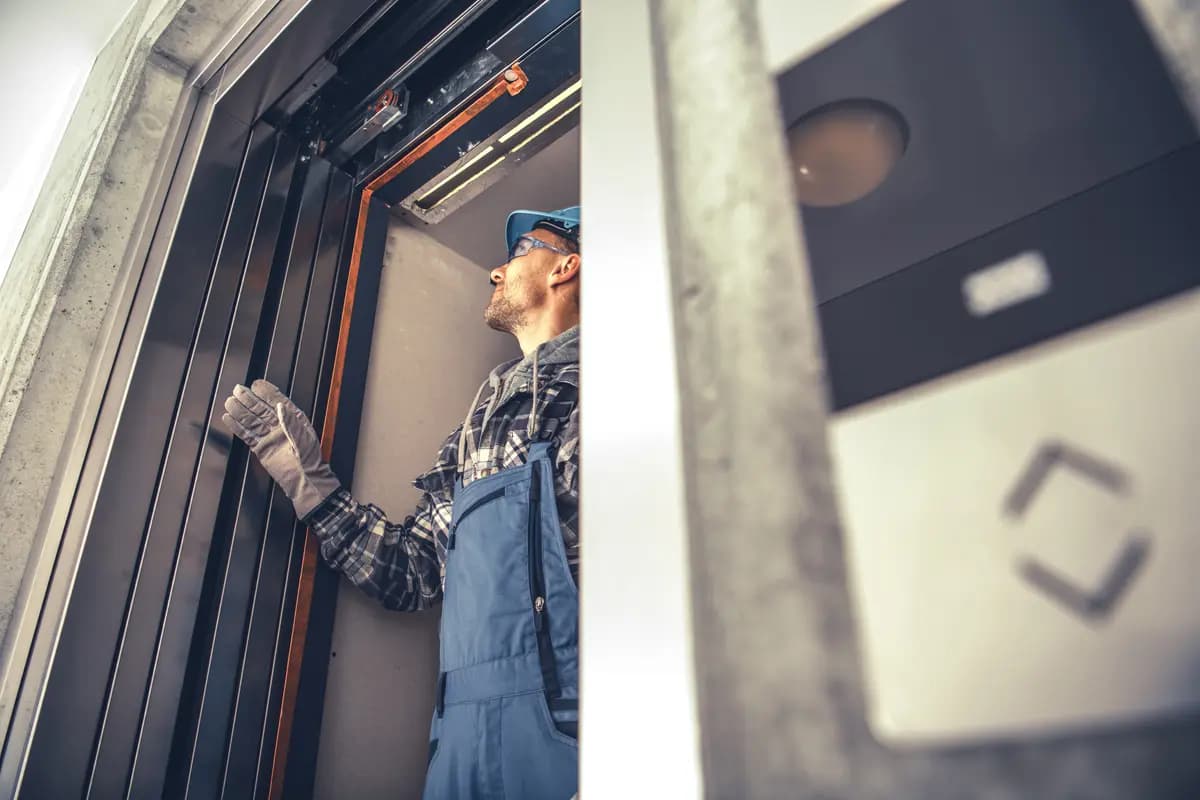
Smart Elevator by RnD Square
The complete smart elevator solution, built to your spec.
IoT hardware and firmware inside the panel. Monitoring, ticketing, maintenance, and dispatch above it. CRM, ERP, and accounting around it. One engineering partner builds the whole stack to the way your elevator company already works.
IoT
Hardware and firmware built in house
Ops
Tickets, maintenance, dispatch, analytics
Business
CRM, ERP, accounting, AMC billing
Spec
Workflows written to match your company
The problem
Elevator companies run on five systems that do not talk.
The lift already produces data. The controller holds fault registers, motor current, trip counts, and door cycles. Meanwhile the service business runs on memory, message threads, and a billing tool that has never seen a fault code. Digitizing one slice of that does very little. The value appears when the panel, the field team, and the ledger share a record.
The software was never chosen, it accumulated
A monitoring tool bought in one year, a maintenance spreadsheet started by a supervisor, quotes living in email, complaints arriving on WhatsApp, and accounts in a package nobody opens until month end. Every handoff between those tools is a place where a fault gets missed or an invoice never goes out.
Fixed SaaS forces your workflow to bend
Most elevator platforms ship one approval chain, one ticket lifecycle, and one billing model. If your AMC contracts, regional structure, or sign-off rules differ, you work around the product with side spreadsheets, which puts you back where you started.
Generic IoT gateways cannot read a lift controller
Off-the-shelf gateways report voltage and temperature. They do not know the car is at floor seven, that the controller threw fault 214, or that door cycle time has drifted by 400 ms since spring. Elevator data needs controller-specific hardware and firmware.
The money layer is left out entirely
Competing platforms stop at monitoring and tickets. AMC renewals, spare parts inventory, proposal approvals, technician cost, and invoicing stay outside. That is exactly where margin disappears, and it is the part nobody builds for elevator companies.
Built to spec
The product bends to you, not the other way round.
Every elevator company has rules that took years to settle. Which faults escalate at night. Who signs off a modernization quote above a certain value. How an AMC renewal is priced when a building adds two units mid-term. Which spares a branch may draw without a purchase order. Those rules are the business.
A fixed platform treats them as edge cases and asks you to approximate. We treat them as the specification and write them into the system, from the firmware alert thresholds up to the invoice logic.
RnD Square works as your extended R&D team. Hardware engineers, embedded developers, and platform engineers in one group, so there is no gap between the board in the panel and the report on the finance desk.
Four layers, one system
IoT layer
Interface hardware and controller-specific firmware that turn panel signals into structured events.
Operations layer
Detection, ticketing, maintenance, dispatch, proposals, service history, and analytics.
Business layer
CRM, ERP, accounting, AMC billing, and account management on the same record.
Custom workflows
Your approval chains, states, forms, and reports written into the product itself.
- Reads live controller data per panel type
- Raises tickets from real fault events
- Schedules maintenance from condition and calendar
- Dispatches technicians by skill and location
- Tracks AMC contracts, spares, and renewals
- Bills from the same record operations run on
Layer one
The IoT layer starts inside the panel.
Everything above depends on this. If the edge device cannot read your controller correctly, the dashboard is guesswork and the prediction model is noise. RnD Square designs the board and writes the firmware in house, per controller type, which is why legacy and proprietary panels other platforms skip are readable here.
Tell us your controller types and how your service business runs. We will come back with a scoped build plan.
Book a technical assessment →Layer two
The operations layer turns signal into action.
A fault event is worth nothing until it becomes a ticket, a technician on site, a part consumed, a record written, and an invoice raised. The operations layer carries that chain end to end, with every state change timestamped so SLA performance can be proved rather than argued.
Layer three
The business layer is the part competitors leave out.
Elevator revenue lives in AMC contracts, spares, modernization work, and renewals. All of it depends on service data that usually sits in a different system from the ledger. When CRM, ERP, and accounting read the same records as operations, a contract can be priced from real fault history and a month end stops being a reconstruction exercise.
Layer four and beyond
Where the spec gets written into the code.
Two companies with identical elevators can run completely different businesses. These pages cover the parts that carry that difference: the workflow engine, the quoting and approval chain, and the permanent record behind every warranty claim and SLA dispute.
Who this is for
Fifty lifts or five thousand.
Elevator OEMs
Ship a connected product with your own branding, from the interface board to the customer portal.
AMC and service companies
Run contracts, tickets, technicians, and billing from one record instead of five tools.
Modernization and retrofit integrators
Add monitoring to older lifts where controller variety is the hard part.
Distributors and dealers
Track installed base, warranties, renewals, and service revenue across every account you hold.
Engagement model
How the build actually runs.
Discovery and controller survey
We document controller types, protocols, the spread of your elevators, current tools, and the workflows that are breaking. You get a feasibility read and a scoped build order before engineering starts.
Spec definition
Your ticket lifecycle, AMC structure, approval chains, rate cards, and reporting needs are written down as the actual product spec. This is the step fixed SaaS skips.
Hardware and firmware build
Interface hardware designed per controller, firmware written per protocol, then validated against live panels until the decoded data matches what the controller is really doing.
Platform build and configuration
Operations, CRM, ERP, and accounting modules configured and extended to the spec. Regions, sites, teams, SLA tiers, and alert routing set up around your structure.
Deployment and rollout
Hardware produced and installed, devices commissioned per unit, and each installation validated live on the dashboard before it is signed off.
Handover and continued engineering
Your team is trained on the platform, OTA capability is live, and the engineering relationship continues for new controller types, new modules, and new workflows.
Build, buy, or partner
How this compares to your other options.
Elevator companies weighing digitization usually look at three routes: license a fixed elevator SaaS product, stand up an internal team, or engage an engineering partner that builds the stack to spec.
| Criteria | Smart Elevator, built to spec | Fixed elevator SaaS | Build in house |
|---|---|---|---|
| Scope of the product | IoT, operations, CRM, ERP, accounting, custom workflows | Monitoring and tickets, sometimes maintenance | Whatever you can staff and finish |
| Fit to your workflow | Built to your spec, including approvals and billing rules | Configuration inside fixed limits | Exact fit, at full build cost |
| Controller coverage | Hardware and firmware written per controller type | Supported list only, legacy panels often excluded | Needs embedded hires and lab time |
| Accounting and AMC billing | Part of the same system as service data | Usually out of scope | Separate project |
| Who owns the deployment | You own the product and the data | Vendor owns the platform | You own it and maintain it |
| Vendor accountability | One team for hardware, firmware, and software | Software vendor plus a hardware vendor | Internal, competing with your product roadmap |
Scope of the product
Built to spec: IoT, operations, CRM, ERP, accounting, custom workflows
Fixed SaaS: Monitoring and tickets, sometimes maintenance
In house: Whatever you can staff and finish
Fit to your workflow
Built to spec: Built to your spec, including approvals and billing rules
Fixed SaaS: Configuration inside fixed limits
In house: Exact fit, at full build cost
Controller coverage
Built to spec: Hardware and firmware written per controller type
Fixed SaaS: Supported list only, legacy panels often excluded
In house: Needs embedded hires and lab time
Accounting and AMC billing
Built to spec: Part of the same system as service data
Fixed SaaS: Usually out of scope
In house: Separate project
Who owns the deployment
Built to spec: You own the product and the data
Fixed SaaS: Vendor owns the platform
In house: You own it and maintain it
Vendor accountability
Built to spec: One team for hardware, firmware, and software
Fixed SaaS: Software vendor plus a hardware vendor
In house: Internal, competing with your product roadmap
FAQ
What elevator companies ask first.
A smart elevator solution connects every lift to a system that reads live controller data and runs the business around it. The complete version has four layers: IoT hardware and firmware inside the panel, remote monitoring and fault prediction, an operations suite for tickets, maintenance and dispatch, and a business layer covering CRM, ERP, accounting and AMC billing.
Start here
The three pages most people read next.
Your extended R&D team.
Bring your controller list, your contract structure, and the workflows that keep breaking. We will tell you what can be built, in what order, and what it takes.