

The Electronics Production Test Sequence, Step by Step
Visual inspection, cold test, current-limited power-up, functional test, assembly test, QC. The standard PCB production test flow and why the order matters.
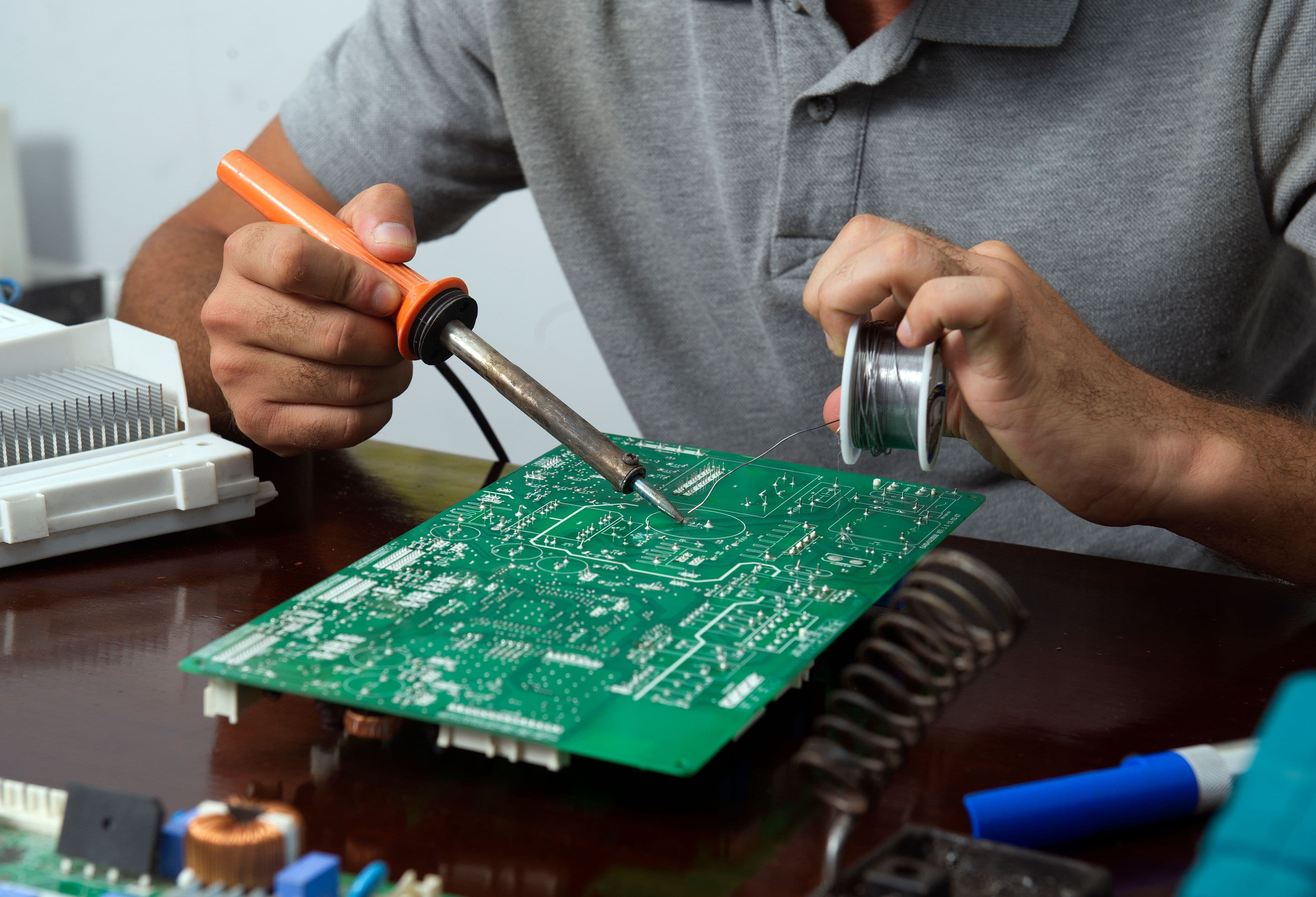
The standard electronics production test sequence runs in this order: visual inspection, cold test against a golden sample, current-limited power-up, firmware load and functional test, mechanical assembly test, final assembly, QC and dispatch. The order is not arbitrary. Each step is designed to catch a class of fault before the next step can damage the board or hide the evidence.
Step 1. Visual inspection
The first test after assembly is a human or automated visual comparison against a known-good reference board.
What it catches: missing components, wrong orientation, tombstoned parts, solder bridges, insufficient or excess paste, damaged pads, wrong component values where the marking is readable, foreign material.
Why it comes first: every one of those faults will either fail a later electrical test with an ambiguous symptom, or worse, cause damage when power is applied. A solder bridge across a supply rail found by eye costs nothing. The same bridge found by a power-up test can take out a regulator and a load.
Practical requirement: the reference board must be a controlled, documented golden sample, not "the one on the shelf". It needs a revision, a variant and a record.
Step 2. Cold test
The cold test measures impedance between defined test points on an unpowered board and compares the readings against the golden sample.
What it catches: shorts and opens that visual inspection missed, particularly under components and on inner layers. Wrong-value passives in critical positions. Incorrectly populated polarised parts. Component damage from handling or ESD.
Why it comes second: it is the last non-destructive test. Everything after this point involves energy, and an undetected short after this step becomes a damaged board rather than a repairable one.
Practical requirement: a defined list of test point pairs with expected impedance ranges and tolerances, derived from the golden sample and documented per variant. "Check it looks similar" is not a cold test.
Step 3. Current-limited power-up
Power is applied for the first time, through a supply with a deliberately low current limit.
What it catches: any remaining short or excessive load. A board that draws its expected quiescent current passes. A board that hits the current limit is pulled before anything is damaged.
Why the current limit matters: this is a safety net for the board, the operator and the test equipment. Setting the limit slightly above expected inrush and quiescent draw means a fault condition stops the test instead of destroying components and obscuring the original defect.
Practical requirement: the expected current window should be recorded as a measured value per unit, not just pass or fail. Current draw at power-up is one of the most sensitive early indicators of a component lot problem, and it is free to collect.
Step 4. Firmware load and functional test
The board is loaded with production test firmware and the full functional sequence is run.
What it catches: everything that is electrically connected but functionally wrong. Relay drivers, display segments, backlight, buttons and touch, buzzer and audio, RTC and its backup, external memory, sensors and ADC channels, cellular or Wi-Fi connectivity, RF signal strength, isolated interfaces, current sensing accuracy, protection circuits.
Why it needs dedicated test firmware: application firmware exercises only what it needs to run and reports nothing structured. A production test build drives every function deliberately, measures rather than merely detects, completes in one to two minutes, and emits machine-readable results.
Practical requirement: every functional test records its measured value and its limits. Boards that pass in the outer five percent of a limit window are the ones that come back from the field, and you can only identify them if the number was stored.
Step 5. Mechanical assembly and assembly test
The board goes into its enclosure, with gaskets, glands, connectors, antennas, displays and any mechanical interfaces fitted.
What it catches: pinched cables, misaligned displays, antenna connections disturbed during assembly, incorrect torque, gasket seating, ingress path defects.
Why a separate test: assembly changes electrical behaviour. Antenna performance in free space is not antenna performance inside a metal enclosure. A connector that mated on the bench can be strained by an enclosure fit. A functional test before assembly does not cover any of this, which is why a post-assembly retest of the assembly-sensitive subset is necessary.
Step 6. Final assembly, QC and dispatch
Labelling, serial number application, firmware finalisation, packaging, and a final quality check against a documented checklist.
The critical action at this step is overwriting the production test firmware with the released application firmware, and recording that the overwrite completed. Test builds usually expose direct control of outputs and diagnostic shells that must never leave the factory.
The part most teams get wrong: the line is not one person
A production line is not a single sequence run by a single operator. It is several stations running in parallel at different rates.
One operator may run cold test for the whole line. Three may run functional test, because functional test is the slowest step. Two may run assembly. The staffing ratio changes with the product and the volume, and it changes again when the line scales.
This is where paper and spreadsheets break completely. Results from six stations, three shifts and two variants have to land in one place, attributed to the right serial number, without an operator retyping anything.
S3Suite handles this with the Station Kiosk. Each operator station is provisioned as its own kiosk instance. The operator selects the test they are running and the variant being built, and results log centrally against each unit. The model expands linearly, so a line with fifty operators works the same way as a line with five, and no station's data is lost because someone did not send a spreadsheet at the end of the shift.
Why skipped steps are the real risk
Under schedule pressure, the steps most often shortened are the cold test and the outer edges of the functional test. Both are invisible omissions. The unit ships, it works, and the consequence arrives months later.
The only defence is a system where a unit cannot progress without its prior test record existing. If step four can be completed on a unit that has no step two record, step two will eventually be skipped. Enforcing sequence at the system level is more reliable than enforcing it through supervision, particularly at a contract manufacturer you do not visit weekly.
FAQ
What is a cold test in PCB production?
An unpowered impedance measurement between defined test points, compared against a golden reference sample, used to detect shorts, opens and wrong components before power is applied to the board.
Why is the first power-up current limited?
To prevent a remaining short or excessive load from destroying components. A current-limited supply stops at a defined threshold, leaving the original fault intact and diagnosable rather than masked by secondary damage.
What is the difference between functional test and assembly test?
Functional test verifies board-level electrical function before the enclosure. Assembly test verifies the subset of functions that assembly can affect, such as antenna performance, display alignment, connector seating and ingress sealing.
How many operators does a production test line need?
It depends on cycle time per step. Functional test is usually the bottleneck and often needs multiple parallel stations, while cold test and power-up may need only one each. The staffing ratio should follow measured cycle times, not equal division.
How do you stop production steps being skipped?
By enforcing sequence in the system rather than by supervision. If a unit cannot enter a later step without a recorded result from the earlier one, skipping becomes visible immediately rather than at the end of the build.
CTA: See how Station Kiosk runs multi-station test flows with per-unit records. [Explore the Manufacturing Suite]
Internal links: /insights/production-test-firmware-for-hardware-manufacturing, /insights/production-rework-tracking-and-traceability, /insights/automated-test-jigs-electronics-production, /s3suite