

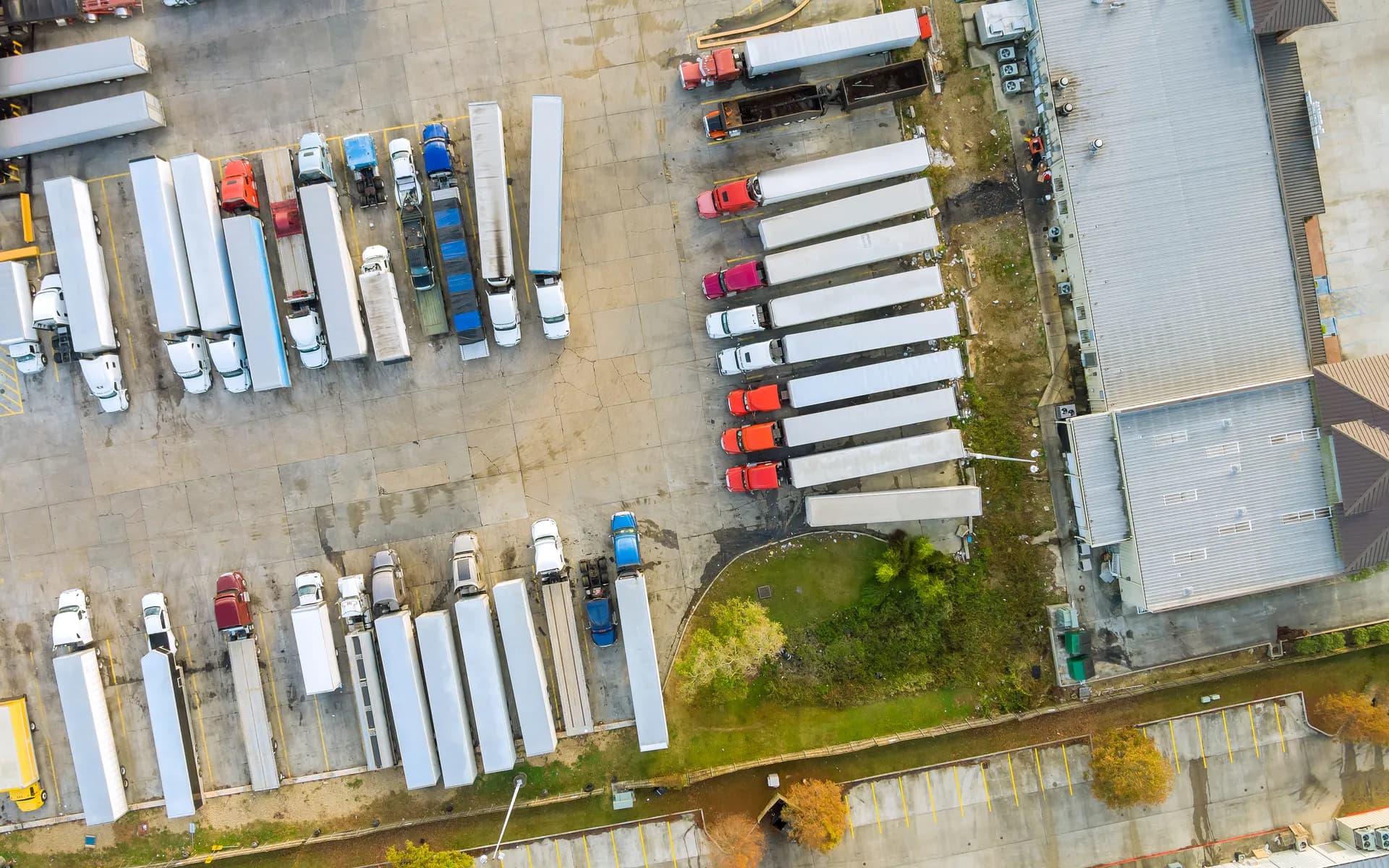
Yard Management
Telematics
A full-stack yard telematics platform for tracking every trailer and asset across your yard, automating dock assignment, and measuring dwell time. The system fuses GPS with BLE and UWB positioning so a trailer reads as a dock door or staging slot rather than a drifting coordinate.
 THE CHALLENGE
Yards Run Blind Between the Gate and the Dock
Most logistics yards lose track of trailers the moment they pass the gate. Spotters drive around looking for units, dock doors sit idle while trailers wait in staging, and dwell-time disputes with carriers come down to a clipboard and a guess. Manual yard checks are slow and out of date within minutes. Closing that gap means giving every trailer and asset a live position, every zone a defined boundary, and every dock a status the control room can see in real time.
One layer of the full Telematics and GPS Tracking platform, working closely with Asset Tracking Solutions.
WHAT'S INCLUDED
Hardware and Software for the Whole Yard
Yard Trackers and Trailer Tags
Outdoor GPS trackers for yard trucks and spotters, plus low-power BLE and UWB tags for trailers and chassis. Trailer tags run on multi-year batteries and report position along with a coupled or uncoupled state, so you know which units are ready to move.
Indoor and Outdoor Positioning
GPS for the open yard is fused with fixed BLE and UWB anchors near docks, canopies, and buildings where satellite signals break down. The result is a continuous position that holds accuracy from the gate to inside the dock apron.
Zone-Level Geofencing
Gate, staging, parking, and dock-apron zones are defined as geofences. Every entry, exit, and dwell event is timestamped so a trailer reads as Staging Row C or Dock 14, and the dashboard shows live occupancy per zone.
Dock Door Automation
Door open and close status, restraint, and light signals are read and tied to trailer position. Inbound trailers are assigned to free doors, live door occupancy is shown, and doors blocked by a trailer that has overstayed are flagged.
Gate and Check-In Integration
Barrier controllers, RFID and ANPR readers, and driver check-in kiosks integrate at the gate. Arrival and departure events are captured automatically and matched to appointments, so the yard log builds itself without manual entry.
Yard Dashboard and Reports
A live yard map shows trailer positions, zone occupancy, and dock status, with dwell-time and detention reports you can hand to carriers. Spotters get move tasks on a mobile app and confirm them as they go.
POSITIONING STACK
The Right Technology for Each Yard Zone
No single positioning technology works across an entire yard. GPS, BLE, and UWB are layered so accuracy matches what each zone needs, and the backend fuses them into one position per asset.
GPS for the Open Yard
A u-blox GNSS receiver gives 3 to 5 metre accuracy across the open yard and gate area. That is enough to separate staging rows, parking blocks, and the dock apron, and it needs no fixed infrastructure.
BLE for Zone Presence
Battery BLE tags and fixed anchors confirm which zone a trailer sits in even under canopies and near buildings where GPS drops. BLE is low cost and low power, ideal for tagging hundreds of trailers and chassis.
UWB for Door-Level Accuracy
Where adjacent dock doors or parking slots must be told apart, UWB anchors bring accuracy under half a metre. UWB is deployed only at the docks where slot-level resolution earns its cost.
ARCHITECTURE
From Tag to Yard Dashboard
Edge Devices and Anchors
Yard trackers and gate units run firmware on an STM32 with a u-blox GNSS module and a cellular modem. Fixed BLE and UWB anchors stream presence data over the yard network to a local gateway.
Ingestion and Fusion
Devices publish over MQTT to a broker. A fusion service merges GPS, BLE, and UWB into one position per asset, runs the geofence engine, and writes zone transitions and dwell events into a time-series database.
Yard Logic and APIs
The dock-assignment engine matches inbound trailers to free doors and appointments. REST APIs and webhooks expose arrival, departure, dock, and dwell events to your WMS and TMS so yard moves flow into the systems you already run.
STANDARDS AND INTEGRATION
Built to Fit Your Yard and Your Stack
Outdoor-Rated Hardware
Yard units and gate enclosures are sealed to IP67 with wide-temperature components and surge protection. Trailer tags run on multi-year batteries so seasonal weather and constant vibration do not put units out of service.
Gate and Dock Protocols
Barrier and door controllers integrate over Modbus and dry contacts, RFID and ANPR readers over their native APIs, and check-in kiosks over REST. Door and restraint signals map directly to dashboard status.
WMS and TMS Integration
Arrival, departure, dock assignment, and dwell events publish over REST and webhooks. They push into your WMS and TMS, and appointment data is pulled back to drive dock scheduling, with no rip-and-replace of your existing systems.
FAQ
Common Questions
How do you track trailers and assets inside a yard where GPS is unreliable?
GPS for the open yard is combined with BLE and UWB anchors for areas near buildings, under canopies, and inside docks. The tracker reports a fused position, and the backend snaps it to a known yard zone so a trailer reads as "Dock 14" or "Staging Row C" rather than a raw coordinate that drifts a few metres.
What zone resolution can be achieved for geofencing?
Outdoor zones from GPS are accurate to roughly 3 to 5 metres, which is enough to separate gate, staging, and dock-apron areas. Where door-level or slot-level resolution is needed, UWB anchors bring accuracy to under half a metre, so the system distinguishes adjacent dock doors and parking slots.
Can the system integrate with your gate and dock door controls?
Yes. At the gate, integration covers barrier controllers, RFID or ANPR readers, and check-in kiosks over Modbus, dry contacts, or REST. At the dock, door open and close status plus restraint and light signals are read so the dashboard shows live door occupancy alongside trailer position.
How is dwell time and detention measured?
Every zone transition is timestamped on the backend. Dwell time is computed per trailer per zone, trailers that exceed a configured threshold are flagged, and detention reports can be handed to carriers. Alerts fire when a trailer sits in a staging zone past its target turnaround.
Does the hardware survive an outdoor yard environment?
The yard trackers and gate units are built for outdoor duty with sealed enclosures rated to IP67, wide-temperature components, and either solar plus battery or wired power for fixed anchors. Trailer tags run on multi-year batteries so units do not need servicing every season.
Can this run without ripping out your existing WMS or TMS?
Yes. The yard platform exposes REST APIs and webhooks for arrival, departure, dock assignment, and dwell events. These events push into your WMS or TMS so yard moves appear in the systems your team already uses, and appointment data can be pulled back to drive dock scheduling.
Ready to See Your Whole Yard in Real Time?
Share your yard size, trailer volume, and dock count to get a tailored walkthrough of the positioning stack, the dock-assignment logic, and how it integrates with your WMS and TMS.
Schedule a Free Consultation