

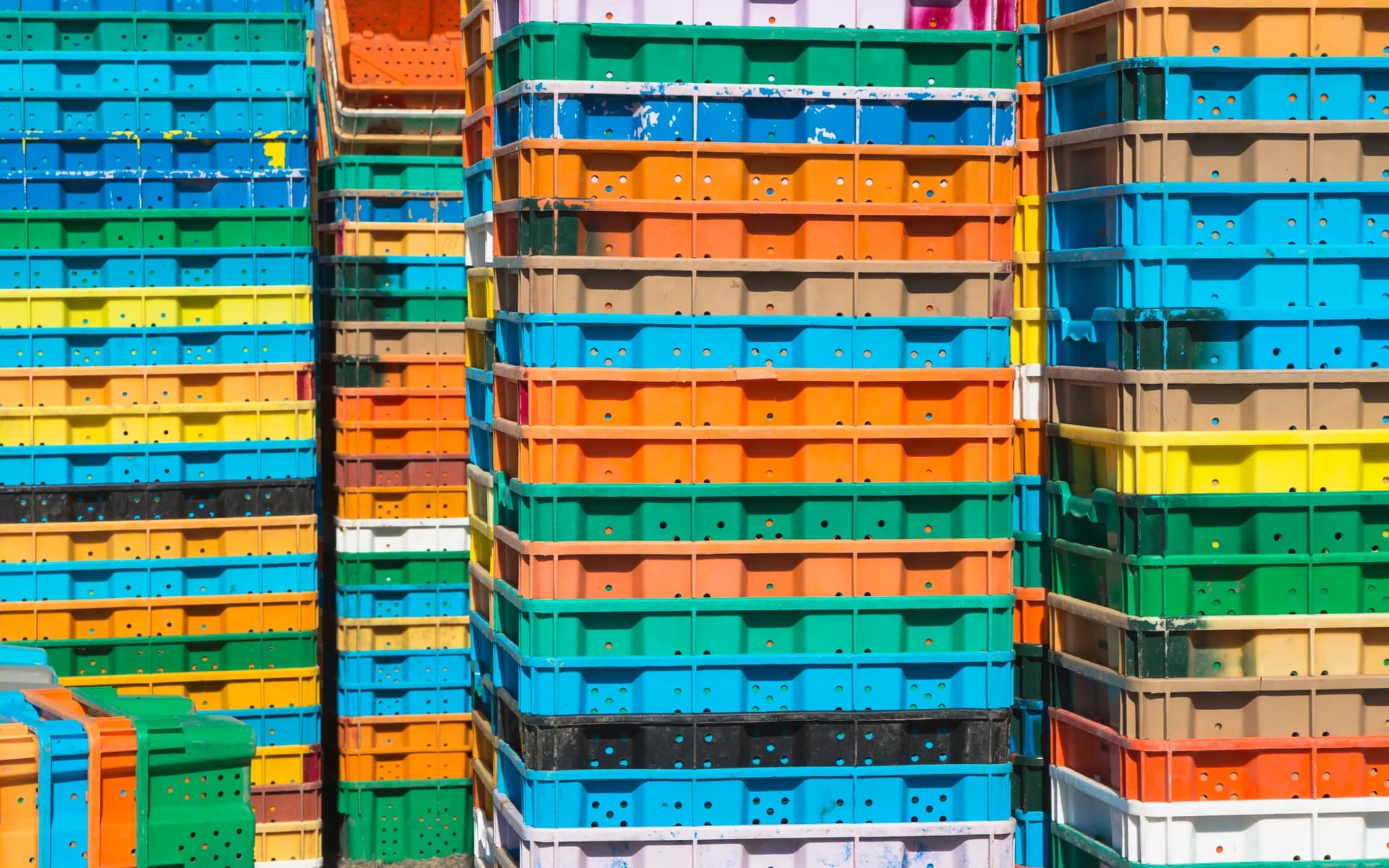
Returnable Asset and
Pallet Tracking
A BLE tag and GPS gateway system that tracks pallets, crates, kegs, and rolling cages across your returnable transport item pool. Ultra-low-power tags last years on a coin cell, gateways read them at depots and on trucks, and the platform shows where every asset sits, how fast it cycles, and where the pool is leaking.
 THE CHALLENGE
Returnable Pools Leak Money You Cannot See
A returnable transport item pool of pallets, crates, dollies, and stillages is a rolling asset base worth millions, yet most operators run it on spreadsheets and trust. Items disappear into customer sites, sit idle on a dock for weeks, or quietly get scrapped, and the first sign of trouble is a purchase order for thousands of replacement units. Putting an active GPS tracker on every crate is too expensive and too power hungry to survive a wash cycle. The fix is cheap BLE tags on the assets and a smaller number of GPS gateways at the choke points, so the pool gets full visibility without powering a cellular radio on every item.
Built within the Telematics and GPS Tracking ecosystem, and frequently paired with Asset Tracking Solutions.
WHAT'S INCLUDED
A Two-Tier BLE Tag and GPS Gateway System
Ultra-Low-Power BLE Asset Tags
BLE 5.0 tags built around Nordic nRF52 silicon advertise a unique ID on a duty cycle tuned to your read frequency. On a single CR2477 coin cell or a small primary lithium pack, a tag runs three to seven years. The electronics are potted for IP67 so the tag survives wash bays, rain, and forklift abuse.
GPS and Cellular Gateways
At depots, dock doors, and on trucks, gateways built on an ESP32 or STM32 host with a Quectel BG95 or EC200 modem do the reading. Each gateway scans for BLE tags in range, stamps them with GPS position and time, and pushes the batch to the cloud over MQTT so you know which assets passed which point.
Fixed Reader Infrastructure
For high-throughput sites, mains-powered fixed readers sit on dock doors and gate lanes. As a loaded pallet rolls through, the reader logs the tag and ties it to the shipment, the truck, and the destination, turning every gate crossing into a clean pool movement event.
Pool Management Platform
The software turns tag reads into a live asset register. You see every item by location, dwell time, custody, and cycle count. The platform flags assets that have sat too long at a customer site, units overdue for return, and depots running short of stock.
Cycle Counting and Audit
Reader-driven cycle counting replaces manual stock takes. A handheld BLE scanner or a gate reader counts a full bay in minutes, reconciles it against the expected register, and produces a signed count you can use for billing reconciliation with pool partners.
Loss and Shrinkage Analytics
The pool is modelled as a flow to surface where it leaks. The platform shows last-seen location for missing units, customer sites that consistently fail to return assets, and the true scrap rate, so you replace the right number of units instead of over-buying to cover unknown losses.
WHAT YOU GET
Visibility From the Tag to the Pool Ledger
You stop guessing how many pallets are in the field and start managing the pool with the same rigour as your finished goods inventory. The system answers the questions that drive replacement spend and customer disputes.
Where Is Every Asset
A live map and register show the last known location of each pallet, crate, or cage, whether it is in your depot, on a truck, or sitting at a customer dock, with the timestamp of the last read.
How Fast Does It Cycle
Trip time, dwell at each node, and turns per year per asset class are all measured. Slow-cycling assets are working capital tied up, and the platform shows exactly where they stall.
Who Has Custody
Every gate read assigns custody to a site, carrier, or customer. When a unit goes missing, the ledger shows who held it last, which ends the finger-pointing in pool disputes.
HOW IT WORKS
From BLE Advertisement to Pool Event
Tags Advertise
Each BLE tag wakes on its duty cycle and broadcasts an encrypted ID and battery state. Between broadcasts it sits in deep sleep drawing microamps, which is how a coin cell lasts years.
Gateways Resolve and Locate
A nearby gateway or fixed reader hears the advertisement, attaches GPS coordinates or a known node ID, deduplicates repeated reads, and batches the events to cut cellular cost.
Cloud Builds the Ledger
The backend ingests the batches over MQTT, runs them through a state machine that tracks each asset between nodes, and updates the pool register, dwell timers, and loss alerts in near real time.
ENGINEERING DETAIL
Built to Survive the Pool
Power Budget First
The tag firmware runs on a strict energy budget, choosing advertising interval, transmit power, and sensor sampling to hit your target battery life. Coin cell pulse behaviour is modelled so the tag does not brown out on a cold morning.
Survives Wash and Impact
Returnable assets get power-washed, dropped, and stacked. The tag is potted, qualified to IP67, and mounted where forks and pallet jacks will not shear it off, validated on real handling equipment.
Reads at Scale
A loaded truck can carry hundreds of tagged crates. The gateway firmware handles dense BLE environments without missing tags, filtering noise and confirming each ID before it counts as a movement.
Open Integration
The pool ledger is exposed through REST APIs and webhooks so movements flow into your WMS, ERP, or pool-billing system. Tag events are designed to tie back to SAP and to third-party pool operators for settlement.
FAQ
Common Questions
Why BLE tags instead of GPS trackers on every asset?
A cellular GPS tracker needs frequent charging or a large battery and costs far more per unit than a pallet justifies. A BLE tag on a coin cell runs for years and costs a fraction as much, so you can tag the whole pool. The GPS lives in the gateways and fixed readers, which see the tags at the points that matter.
How long do the tag batteries last?
It depends on advertising interval and read frequency, but a typical pool tag on a CR2477 cell runs three to seven years. The energy budget is sized to the use case during design, and the tags report battery state so you can replace them before they die.
Can the system tell you which customer is holding your pallets?
Yes. Every gate and dock read assigns custody, so when an asset leaves your depot the ledger records the destination and carrier. If a unit does not come back, you can see who held it last and how long it has been overdue.
Do the tags survive washing and rough handling?
The electronics are potted and the tags qualify to IP67, then mount where pallet jacks and forks will not shear them off. They are built for the rough world of power-wash bays, outdoor storage, and being dropped, well beyond what a clean office shelf would demand.
How does cycle counting work without manual scanning?
Fixed readers and handheld BLE scanners count a full bay in minutes by reading every tag in range. The platform reconciles that count against the expected register and produces a signed result, replacing slow manual stock takes.
Can this integrate with your existing WMS or pool-billing system?
Yes. Movements and the pool ledger are exposed through REST APIs and webhooks, and tag events are designed to integrate with SAP and third-party pool operators for settlement and reconciliation.
Ready to Stop Losing Your Returnable Pool?
Share your asset types, pool size, and the sites your items move between to see how a BLE tag and GPS gateway system cuts shrinkage and replacement spend.
Schedule a Free Consultation