

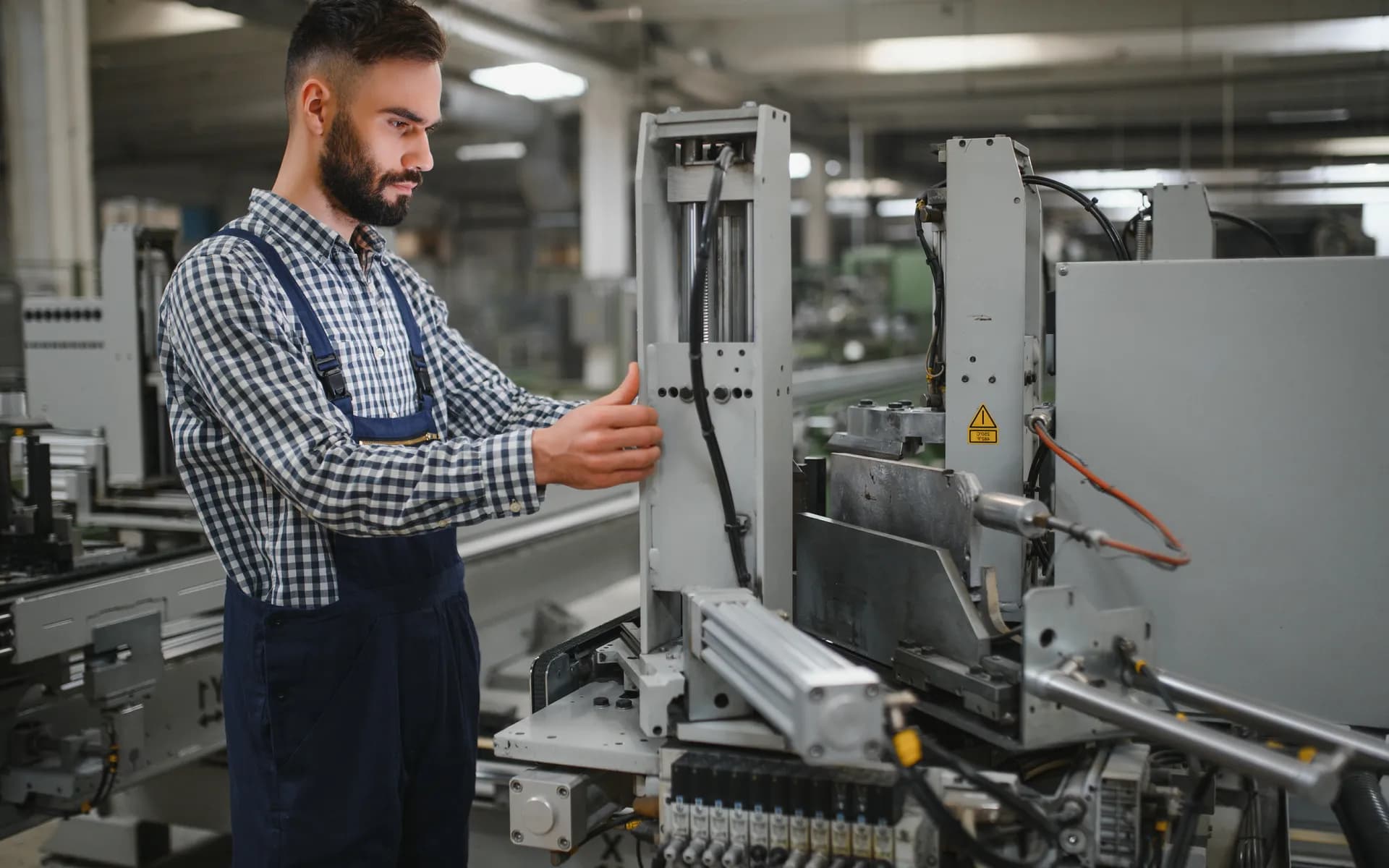
Industrial Machine
Monitoring Telematics
A machine monitoring system for the factory floor: edge gateways that read Modbus and OPC-UA, vibration and temperature sensing for predictive maintenance, and an OEE picture that tells you why a line really stopped. From the gateway firmware to the dashboard.
 THE CHALLENGE
Your Machines Already Talk, Nobody Is Listening
A modern plant is full of data that never leaves the machine. The PLC knows the cycle count, the VFD knows the motor current, the panel knows every fault, but it all sits behind a Modbus register or an OPC-UA node that no one reads after commissioning. So maintenance is still reactive, OEE is a number someone calculates in a spreadsheet at month end, and the first sign of a failing bearing is the line going down. This is the edge layer that listens. Gateways poll the existing controllers, add vibration and temperature sensing where the machine has no instrumentation, and stream a clean, time-stamped picture of every asset to the cloud so the failure is visible weeks before it happens.
A component of the broader Telematics and GPS Tracking capability, often deployed with Remote Equipment and Machine Monitoring.
WHAT'S INCLUDED
From the PLC Register to the OEE Board
Edge Gateways
Industrial gateways sit next to the machine and talk its protocol: Modbus RTU and TCP, OPC-UA, and raw digital and analogue I/O for older equipment. Built on an STM32 or an embedded Linux SoC running FreeRTOS or Linux, DIN-rail mounted, and rated for the panel environment.
Vibration and Temperature Sensing
Where a motor, gearbox, or pump has no instrumentation, it gets added. MEMS accelerometers for vibration signature, RTD and thermocouple inputs for bearing and winding temperature, and current sensing on the drive. This is the raw data that predicts a mechanical failure.
Predictive Maintenance
The vibration and temperature streams become trends and thresholds. A rising vibration RMS, a shift in the spectral signature, or a creeping bearing temperature raises an alert with weeks of warning, so the part is changed on a planned stop instead of a breakdown.
OEE and Downtime Analytics
Availability, performance, and quality are computed from the same machine data, and every stop is tied to a reason code from the PLC fault word. The OEE board shows both the number and the specific cause, so the line team fixes the real bottleneck.
Edge Buffering and Store-and-Forward
The gateway keeps collecting and buffering locally when the network drops, then forwards on reconnect. No data gaps when the plant Wi-Fi or the cellular link hiccups, which matters when you are trending a slow-developing fault.
Dashboards and Alerts
A dashboard shows live machine state, trends, and OEE, and pushes alerts to maintenance over email, SMS, or a webhook into your CMMS. Operators see the floor, managers see the plant, and the data feeds your existing systems over REST.
PROTOCOLS AND CONNECTIVITY
Meeting Your Machines Where They Are
Every plant is a mix of vintages and vendors. The gateways speak the field protocols natively and normalise everything into one model before it leaves the floor, so the cloud sees consistent data whether it came from a new PLC or a 20 year old panel.
Modbus and OPC-UA
Modbus RTU and TCP registers are polled and OPC-UA nodes are subscribed to, each mapped to a named tag with engineering units. For machines with neither, digital and analogue I/O is read directly.
Edge to Cloud over MQTT
The gateway publishes normalised, time-stamped data over MQTT with TLS, using Sparkplug-style topic structure so adding a machine does not break the pipeline. A Cat-M1 or NB-IoT modem covers sites with no wired network.
Local Compute at the Edge
Filtering, feature extraction, and threshold logic run on the gateway so only meaningful data and events travel upstream. That keeps bandwidth low and means an alarm fires even if the cloud link is down.
HOW IT WORKS
From Sensor to Decision
Collect at the Edge
The gateway polls controllers and reads its own vibration, temperature, and current sensors, time-stamps every value, and buffers locally so nothing is lost when the network drops.
Process and Detect
On-gateway logic extracts features, compares against learned thresholds, and raises events. Clean data and alarms stream to the cloud over MQTT, the firehose stays on the floor.
Act
Dashboards show live state and OEE, predictive alerts reach maintenance with lead time, and the data flows into your CMMS and ERP so work orders and planning run off real machine behaviour.
FAQ
Common Questions
Does the PLC programme need to be modified?
Usually not. The gateway reads the existing Modbus registers or OPC-UA nodes the controller already exposes, collecting cycle counts, states, and fault words without touching the control logic. For machines with no exposed data, dedicated sensors are added instead.
How is a machine with no instrumentation at all monitored?
Whatever it lacks gets bolted on. A MEMS accelerometer on the motor or gearbox for vibration, an RTD or thermocouple for temperature, and a current sensor on the drive. The gateway reads these directly, so even an old machine with no network interface becomes monitorable.
What does the predictive maintenance actually detect?
Vibration RMS and spectral features, bearing and winding temperature, and motor current are trended over time. A developing bearing or imbalance fault shows up as a rising trend or a shift in the vibration signature, typically giving weeks of warning before failure, so the repair lands on a planned stop.
What happens when the network goes down?
The gateway keeps collecting and buffers data locally with store-and-forward. When the link returns it forwards the backlog in order, so you get a continuous record. Alarm logic also runs on the gateway, so a critical alert still fires even with no cloud connection.
How is OEE calculated and can the stop reasons be trusted?
Availability, performance, and quality are computed from the machine data directly, and each downtime event is tied to a reason code read from the PLC fault word or an operator entry. Because the stop reason comes from the machine, the OEE losses point at the real cause rather than a guess.
Can this feed your existing CMMS or ERP?
Yes. The data is exposed over REST and events are pushed via webhooks, so machine alerts can open work orders in your CMMS and run-time and OEE figures can flow into your ERP. The monitoring layer adds to your existing systems rather than replacing them.
Ready to Make Your Machines Talk?
Share your plant, the controllers you run, and the machines that keep failing without warning to get a tailored edge-to-cloud monitoring system built around them.
Schedule a Free Consultation