

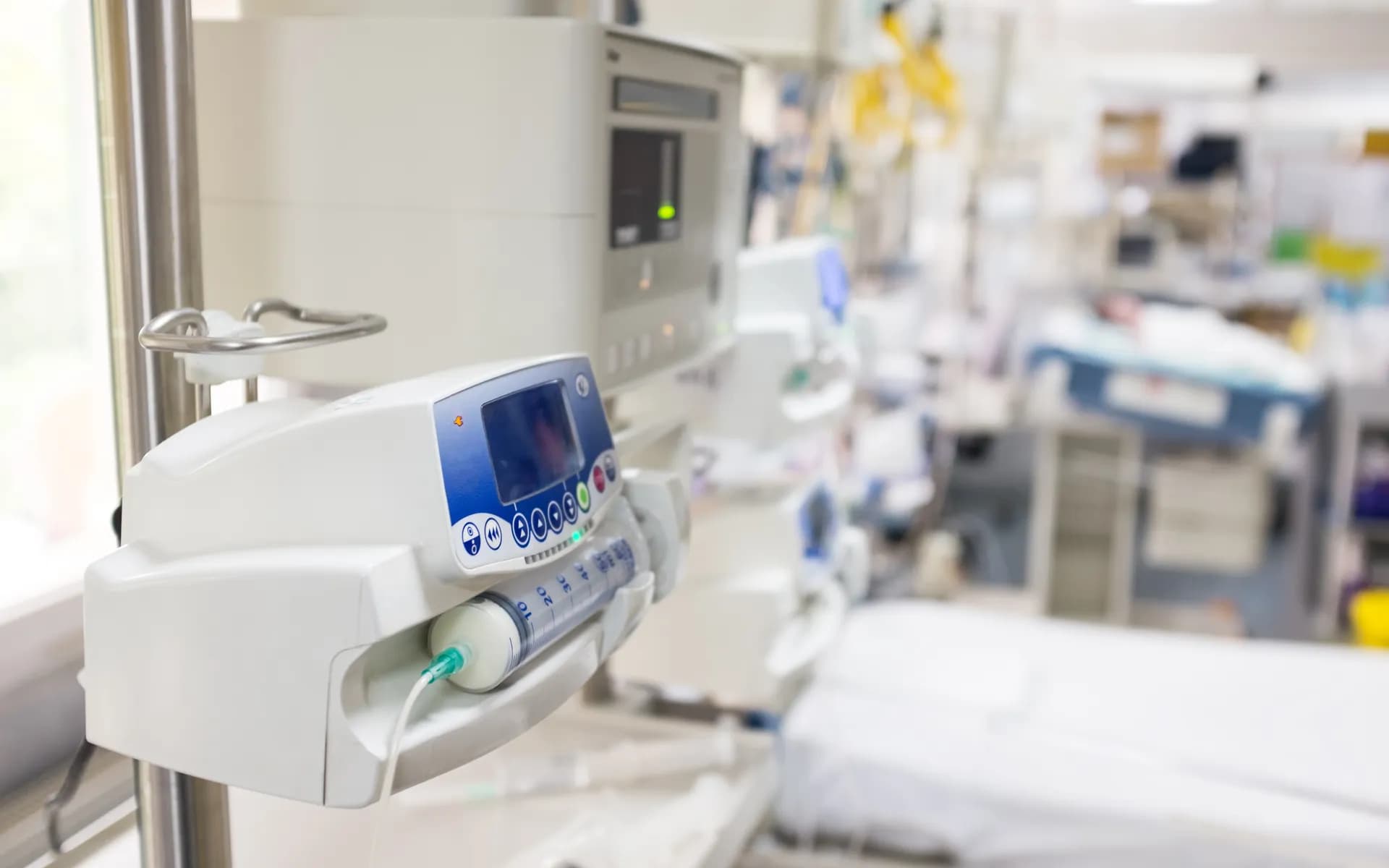
Hospital Medical
Equipment Tracking
Indoor RTLS for hospitals so infusion pumps, ventilators, and wheelchairs are findable in seconds rather than searched for across floors. The build covers the BLE AoA and UWB tags, the anchor infrastructure, and the integration into your hospital systems.
 THE CHALLENGE
Clinical Staff Should Not Hunt for Equipment
In a large hospital, nurses lose real time every shift searching for an available infusion pump or a clean wheelchair, and biomedical teams over-purchase because utilisation is invisible. GPS does not work indoors, and floor-level location matters when an item could be on any of ten wards. An indoor real-time location system using BLE Angle of Arrival and UWB lets each asset report its room or zone, its utilisation, and its readiness, feeding that into the systems clinical and biomedical staff already use.
One layer of the full Telematics and GPS Tracking platform, working closely with Asset Tracking Solutions.
WHAT'S INCLUDED
Indoor RTLS Built for Clinical Environments
BLE AoA and UWB Asset Tags
Small, sealed tags built around Nordic nRF52 BLE silicon for Angle of Arrival, with UWB tags where sub-metre accuracy is required in theatres and ICUs. Housings are wipeable for infection control and rated for the cleaning chemistry hospitals actually use.
Anchor and Locator Infrastructure
Ceiling anchors that compute angle and time-of-flight, planned and installed with PoE backhaul so no anchor needs a separate power run. Anchor density is modelled per ward to hit room-level certainty without flooding the estate with hardware.
Equipment Utilisation Analytics
How long each pump, monitor, or bed is in active use versus idle or parked is measured continuously. Biomedical teams see true utilisation by device class and ward, which is the data that stops unnecessary capital purchases and surfaces hoarding.
Par-Level Management
Par levels are set per ward so the system warns when available stock of a critical item drops below the threshold, and points staff to the nearest available unit. Equipment distribution stops being guesswork and becomes a managed flow.
Sterile and Workflow Awareness
Clean, dirty, and in-use states are modelled so a device returning from a procedure is routed through decontamination before it shows as available. The RTLS reflects sterile workflow rather than raw position alone, so staff trust what the screen says.
Hospital System Integration
Integration covers the CMMS and biomedical asset register, with HL7 and FHIR friendly APIs exposed so location and status flow into the EHR, bed management, and maintenance systems your hospital already runs.
WHO USES IT
The Same Location Data, Three Different Jobs
An RTLS only earns its keep when the people on the ground use it without friction. The views are designed so nurses, biomedical engineers, and operations leaders each get the answer they need from the same underlying location data.
Nursing Staff
A simple search that returns the nearest available, clean device and its room. Less time hunting across wards, more time on patients, with a clear status badge so they never wheel in a dirty unit.
Biomedical Engineering
Utilisation by device class, par-level alerts, and a map of every asset due for preventive maintenance, so service rounds are planned and fleets are right-sized to real demand.
Operations and Finance
Utilisation reports that justify or avoid capital spend, plus loss and shrinkage tracking. Rental returns and recalls are managed against a live register rather than a stale spreadsheet.
HOW IT WORKS
From Tag to Room-Level Truth
Tag Transmits
Each asset tag emits BLE AoA packets, or UWB ranging bursts where sub-metre precision is needed. Tags duty-cycle to extend battery life and wake faster when an accelerometer detects the device is in motion.
Anchors Locate
Ceiling anchors measure angle of arrival and time-of-flight, then fuse readings from multiple anchors to resolve a tag to a room or zone. The location engine filters multipath so a reflection off a steel bed frame does not throw the fix.
Platform Resolves State
The backend ingests location over MQTT with TLS, applies clean, dirty, and in-use rules, computes utilisation and par levels, and pushes status into the dashboards and your hospital systems over HL7 and FHIR friendly APIs.
STANDARDS AND ENGINEERING
Engineered for Hospital Estates
Infection Control Ready
Tags use sealed, wipeable housings rated for hospital cleaning agents, with no exposed seams that trap contamination. Mounting kits suit clinical equipment and beds without compromising the device.
EMC and Coexistence
BLE and UWB radios are tuned to coexist with hospital Wi-Fi and medical telemetry, with EMC discipline so the RTLS does not interfere with clinical equipment and the wireless estate stays clean.
Secure and Interoperable
Anchor to cloud runs over TLS, tags carry per-device keys, and integration uses HL7 and FHIR friendly APIs so the system fits hospital IT governance rather than fighting it.
FAQ
Common Questions
Why do GPS and Wi-Fi fall short for hospital asset tracking?
GPS does not work indoors, and Wi-Fi positioning typically narrows an asset only to a general area rather than a specific room. When an infusion pump could be on any of ten wards, that is not good enough. BLE Angle of Arrival and UWB let the system report the actual room or zone, which is what makes the difference between finding a device in seconds and searching for ten minutes.
How accurate is the location?
BLE AoA gives reliable room-level and zone-level accuracy across general wards. For theatres, ICUs, and other areas where sub-metre precision is needed, UWB is used. Anchor density is planned per area to hit the accuracy each environment actually requires rather than over-building everywhere.
Can the system tell whether equipment is clean and ready to use?
Yes. Clean, dirty, and in-use states are modelled so a device returning from a procedure is routed through decontamination before it appears as available. Staff searching for equipment only see units that are genuinely ready, which is what keeps them trusting the system.
How does utilisation tracking help a hospital?
Active use is measured against idle and parked time by device class and ward. That data shows where you are over-supplied, where stock is being hoarded, and where you genuinely need more units, so capital purchasing is driven by real demand instead of anecdote.
Will it integrate with your CMMS and EHR?
Yes. Integration covers the biomedical CMMS and asset register, with HL7 and FHIR friendly APIs exposed so location and status flow into the EHR, bed management, and maintenance systems. The RTLS fits into your existing hospital IT rather than becoming another island.
How long do the tag batteries last and how are they maintained?
Tags duty-cycle and use motion sensing to extend battery life across multiple years for most asset classes. The platform reports battery state per tag so biomedical teams swap or recharge proactively, and tags are designed for quick replacement without taking the asset out of service.
Ready to Make Your Equipment Findable?
Share your estate, the device classes you need to locate, and the hospital systems you run, to see how an indoor RTLS gives staff room-level answers and gives biomedical teams real utilisation data.
Schedule a Free Consultation