

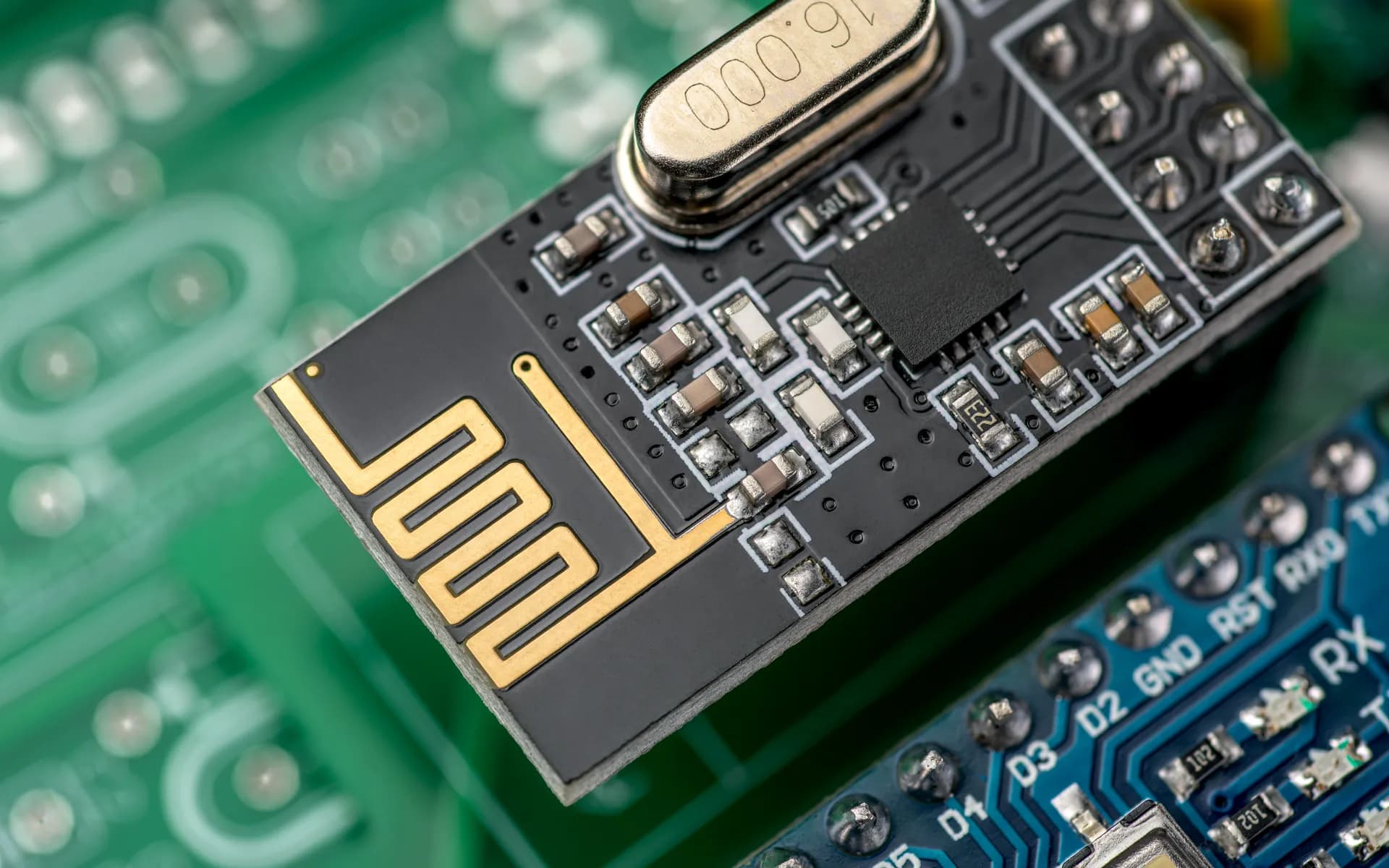
GPS Tracking Device and
Hardware Engineering
GPS tracking devices engineered from the silicon up. GNSS and cellular PCB, RF and antenna, STM32 and ESP32 firmware, OBD-II and CAN, OTA, and ARAI pre-compliance, all in one build.
 THE CHALLENGE
A Tracker Is an RF Problem and a Power Problem
A GPS tracker looks simple until one is built. The GNSS receiver has to hold a fix under a windscreen and through urban canyons, the cellular modem has to reconnect across dead zones without draining the battery, and the antenna layout decides whether the whole thing works at all. Off-the-shelf modules paper over these problems until the device hits real vehicles and real coverage. Hardware and firmware are engineered together, so the RF, the power budget, and the radio behaviour are solved as one system rather than three vendors pointing at each other.
Sits inside the Telematics and GPS Tracking stack and shares hardware and platform building blocks with Telematics Software Development.
WHAT'S INCLUDED
Tracking Hardware, Engineered to Order
GNSS Module Integration
GPS, GLONASS, Galileo, BeiDou, and NavIC support using u-blox and equivalent receivers. Tuned for time-to-first-fix, sensitivity, and dead reckoning where the application needs continuous positioning indoors or in tunnels.
Cellular Connectivity
2G fallback, 4G LTE, NB-IoT, and Cat-M1 built on Quectel and SIMCom modems. Modem AT command stacks handle PDP context and reconnection, with multi-band operation for cross-region fleets.
Tracker Firmware
Firmware on STM32 and ESP32 running FreeRTOS, with a clean state machine for fix acquisition, store-and-forward buffering during outages, and a watchdog discipline that keeps field units recovering on their own.
OBD-II and CAN Devices
OBD-II dongles and hardwired CAN and J1939 trackers that decode engine RPM, fuel level, odometer, DTCs, and speed straight from the vehicle bus and merge it with the GPS stream.
Battery and Power
Deep-sleep architectures, low-quiescent power paths, and solar harvesting for asset tags. The energy budget is sized against reporting cadence so a trailer or container unit runs for months or years between charges.
Antenna and RF
GNSS and cellular antenna selection, impedance matching, and PCB RF layout. Cellular transmit is kept away from the GNSS front end so the modem does not blind the receiver during a data burst.
Device-to-Cloud Protocol
MQTT, raw TCP, or a compact binary protocol chosen against bandwidth and battery. Framing, acknowledgement, and reconnection logic keep the data lossless over flaky links.
Rugged Enclosure
IP-rated mechanical design sized for the mount point, with vibration, dust, and temperature tolerance for vehicles, vessels, and outdoor assets.
OTA Updates
Secure over-the-air firmware update with A/B partitions and rollback, so a field fleet of thousands gets patched without a recall or a site visit.
ARAI and ICAT Pre-Compliance
EMC and EMI design from the layout stage and pre-compliance testing, so the device clears ARAI and ICAT certification without a late redesign.
HARDWARE AND FIRMWARE
Two Disciplines, One Team
Hardware
- Schematic capture and multilayer PCB layout in Altium
- GNSS and cellular RF front-end design and matching
- Power tree, charging, and solar input design
- Component selection for automotive temperature ranges
- Board bring-up, signal integrity, and DFM review
- Enclosure and mechanical integration for IP ratings
Firmware
- STM32 and ESP32 bare-metal and FreeRTOS firmware
- Modem AT stacks for Quectel and SIMCom
- GNSS parsing, fix logic, and dead-reckoning fusion
- Store-and-forward buffering and MQTT or TCP transport
- Deep-sleep power management and wake scheduling
- Secure OTA with A/B partitions and rollback
TECH STACK
The Core Parts List
MCUs
STM32 F and L series, ESP32, with FreeRTOS where the task load needs it.
GNSS
u-blox receivers with GPS, GLONASS, Galileo, BeiDou, and NavIC.
Modems
Quectel EC200 and BG series, SIMCom modules across 4G, NB-IoT, and Cat-M1.
Buses
OBD-II, CAN, J1939, UART, SPI, I2C, and BLE for local provisioning.
Transport
MQTT, TCP, and compact binary framing tuned for battery and bandwidth.
Tooling
Altium for PCB, embedded C and C++, and bench RF and EMC validation.
FAQ
Common Questions
Which GNSS constellations do you support?
GPS, GLONASS, Galileo, BeiDou, and NavIC are supported. The receiver, usually from u-blox, is selected to match the accuracy, time-to-first-fix, and regional mandate the product needs, including NavIC and IRNSS for India.
Do you design the PCB or only write firmware?
Both are in scope. The schematic and multilayer PCB are designed in Altium, the RF section and antenna matching are laid out, the firmware runs on STM32 or ESP32, and the two come together through bring-up and field testing.
Can the device read vehicle data over OBD-II or CAN?
Yes. OBD-II dongles and hardwired CAN and J1939 trackers pull engine, fuel, odometer, and fault data from the vehicle bus and forward it alongside the GPS stream.
How do you handle battery life on asset trackers?
Deep-sleep firmware, low-quiescent power paths, and solar harvesting where the asset allows it. Reporting cadence is tuned against the energy budget so a trailer or container tag can run for months or years.
Do you support certification and EMC testing?
Yes. EMC and EMI are designed for from the layout stage, with pre-compliance so the device reaches ARAI and ICAT certification without expensive late respins.
Have a Tracker to Build?
Share your form factor, your power budget, and your coverage map to scope the PCB, the modem, the firmware, and the certification path, with a clear route to production.
Schedule a Free Consultation